15 February 1942. Singapore.
At 4 o'clock in the afternoon we were told that we had surrendered to the Japanese and must lay down our arms.
He was 21. He would be a prisoner for 1,279 days.
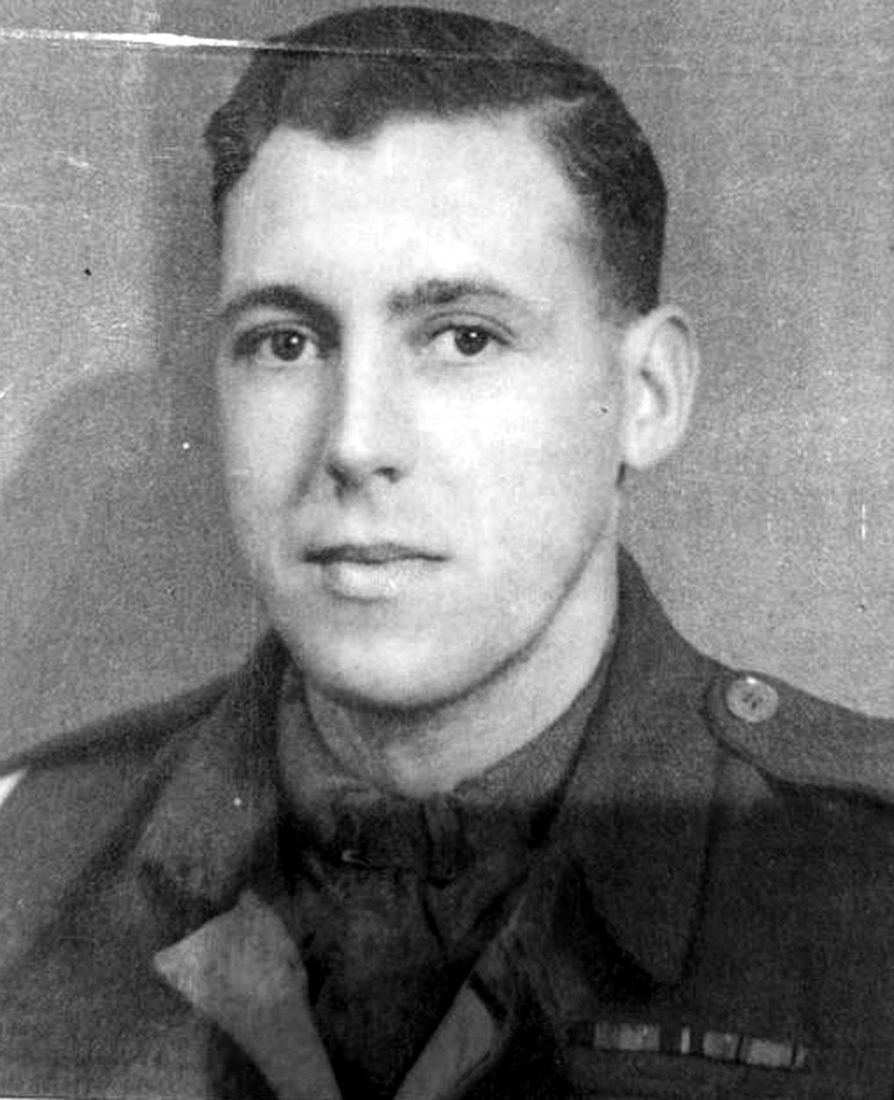
Guest of the Rising Sun
The diary of Gunner Frank Hadfield, Royal Artillery.
Barnsley, 1920 to 1996.
His own title. His own words.
For Dad. 29 November 2026.
This page includes his account of illness and death in the camps.
1920 to 1941. Smithies and Monk Bretton, Barnsley.
A Barnsley man
Frank's diary begins on the day of the surrender. What we know of the years before comes from the family and the papers.
Born 21 November 1920 at Smithies. Burton Road and Raley schools. Apprentice bricklayer and plasterer.
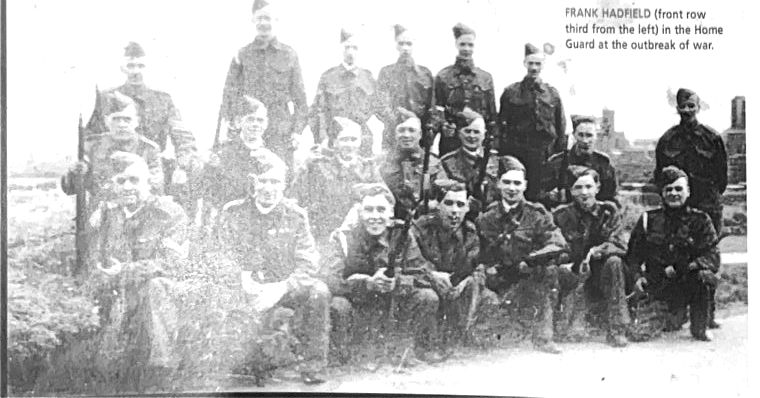
He joined the Home Guard when war broke out and enlisted in the Royal Artillery on 13 March 1941, aged 20.
Gunner 1787095 was sent to Singapore, almost certainly to the 16th Defence Regiment, a coast and beach defence unit.
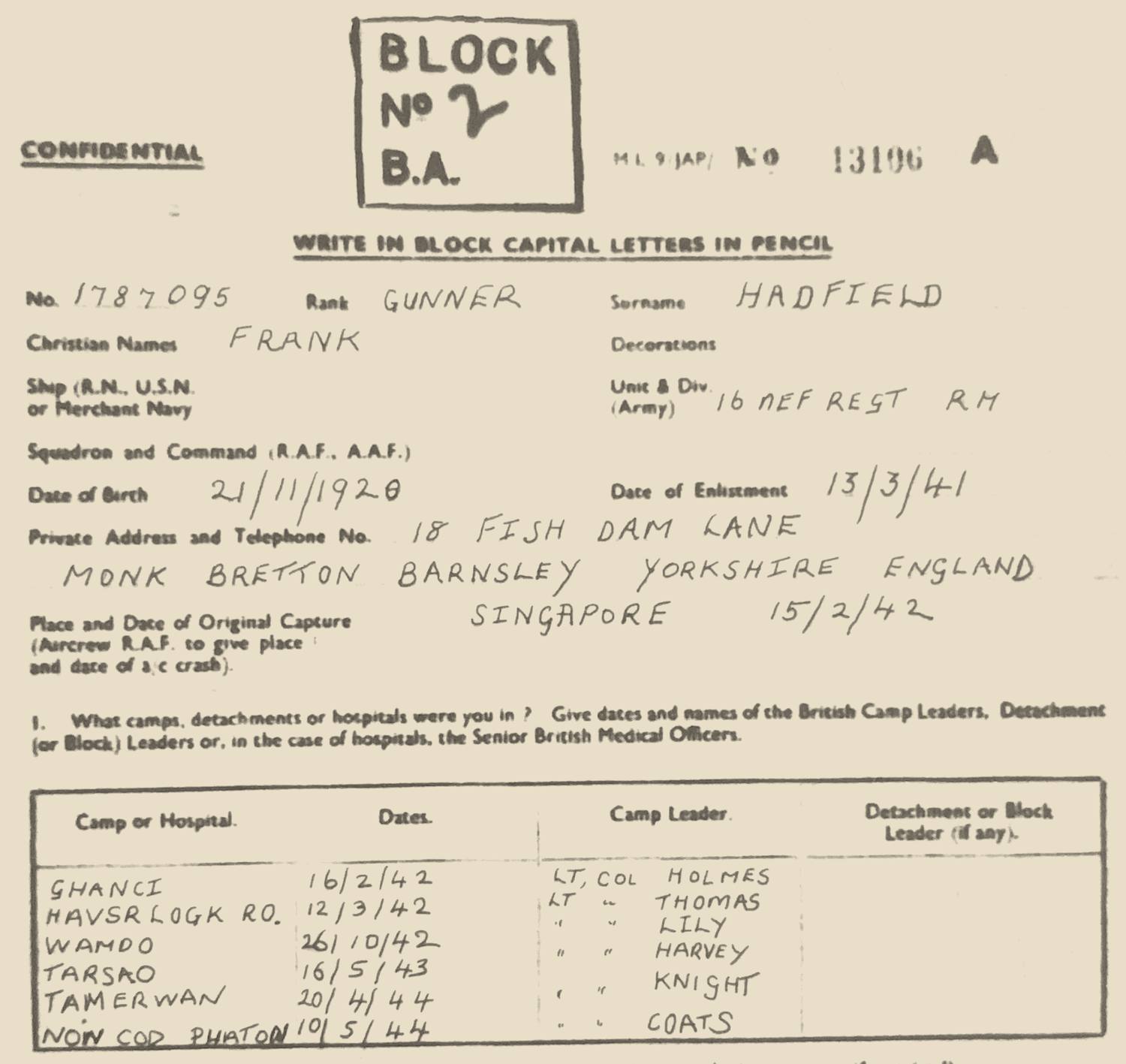
No. 1787095His army number. Rank, Gunner. Christian names, Frank.
18 Fish Dam LaneHis home in 1945. Monk Bretton, Barnsley, Yorkshire, England. Captured at Singapore, 15 February 1942.
In his own handAt the foot, every camp he was held in, each with its date. These pencilled names mark the chapters that follow.
Diary for a P.O.W.
Guest for the rising sun
The first lines of the diary, as Frank wrote them. He later settled on “Guest of the Rising Sun”.
Peter remembers
Dad told him they sailed from Liverpool believing they were bound for Iceland. Only in the Bay of Biscay did they learn the truth. The ship put in at Cape Town on the way east. In Singapore the guns pointed out to sea, because that was where the attack was expected.
15 February 1942. Singapore.
“Our last stand”
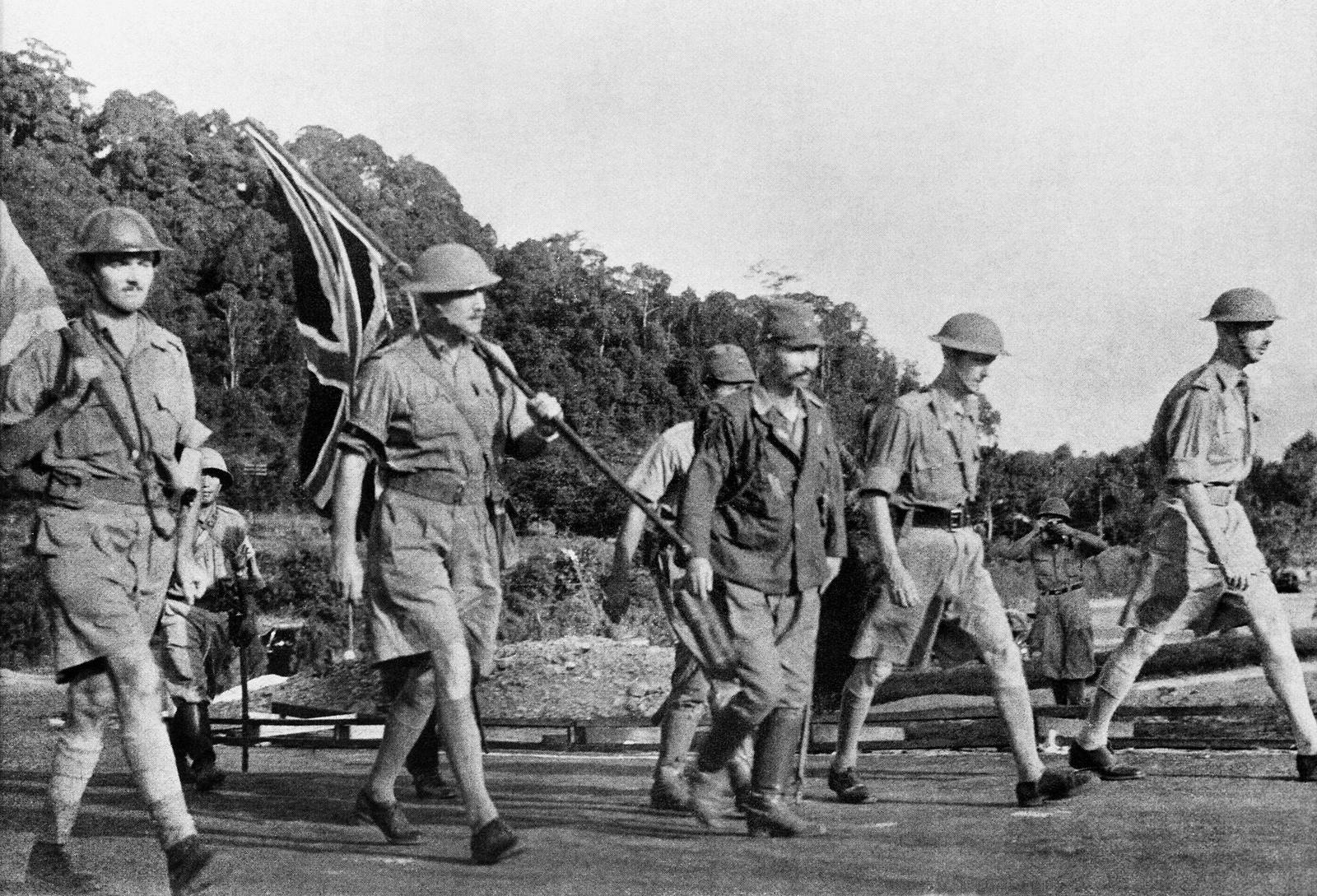
The Japanese came overland, down the Malay peninsula, not from the sea the coast guns were facing.
Lieutenant General Percival went to the Ford Factory at Bukit Timah that day to surrender. The papers were signed in the evening. Frank's unit heard at four.
Fighting was very fierce in Singapore. We had been pushed right down Malaya and knew that this was our last stand. At 4 o'clock in the afternoon we were told that we had surrendered to the Japanese and must lay down our arms. It came to us as a great shock for we then knew that we were POW.
Diary, Feb. 15th 1942More than 50,000 British servicemen became prisoners in the Far East. About one in four did not come home.
A poem by Frank, written as a prisoner.
Then we found with surprise that our water supply
Had all been cut off and the taps had run dry.
The boys still were cheerful but they knew, everyone,
That the hour had come and our last hope had gone.
And that afternoon when expecting the least,
We found on all fronts that the firing had ceased.
It was not the silence that made us all stare -
'Twas a white flag flying that caused our despair.
(one verse on)
We now are British prisoners on the Isle of Singapore,
We've got no guns, and rice is such a bore!
But soon the day will come when we will be free once more,
And the Union Jack will be flying on the Isle of Singapore.
F. H. Changi
Since the day we were taken our spirits have fell,
Although it's not showing it's easy to tell.
After long days of fighting our chances were rare,
For something was missing - the boys in the air.
But our lads kept on slamming the shells up the bore,
Facing death from dive-bombers and mortars galore.
But through all that destruction our spirits were high,
Even smiling at times when shells whistled by.
Still the boys carried on through the long weary night,
Helping those at the Front in their gruesome fight,
But the Japs were so numerous and willing to die,
They fought on and on with help from the sky.
We fought bravely on with our backs to the wall,
In each soldier's heart - "This Island won't fall".
So our guns barked defiance with angry retort,
When came sudden news - "Our ammo's run short!"
So our drivers set forth over death-ridden lanes,
Searching for ammo midst scattered remains.
But the dumps had been taken by Fifth Column spies,
Whose work was successful by glows in the skies.
Our shells were all numbered and handled with care,
Each one that went over in turn did its share.
We kept from each other that dread word - defeat -
And prepared with fixed bayonets the enemy to meet.
Then we found with surprise that our water supply
Had all been cut off and the taps had run dry.
The boys still were cheerful but they knew, everyone,
That the hour had come and our last hope had gone.
And that afternoon when expecting the least,
We found on all fronts that the firing had ceased.
It was not the silence that made us all stare -
'Twas a white flag flying that caused our despair.
The dread word was given that the enemy had won,
And each stout heart asked, like a true British son,
For we had fought hard for that small British isle,
Ready to die to the last rank and file.
We now are British prisoners on the Isle of Singapore,
We've got no guns, and rice is such a bore!
But soon the day will come when we will be free once more,
And the Union Jack will be flying on the Isle of Singapore.
F. H. Changi
February to October 1942. Singapore to the river.
“One cube of tinned pineapple”

Changi. 16 February 1942. Day 2.
Next day we had to march to our old barracks which were named Changi. For the first few days nobody seemed to worry us. Then the Japanese told us that we would now have to live like the Japanese troops. Our rations would be 16ozs of rice per day and a few vegetables if they could get them.
My first meal of rice was eaten with one cube of tinned pineapple. That was dinner.
The whole garrison was held at Changi, at the east end of the island.
The pencilled names are Frank's own. He wrote them on the army form after he was freed in 1945.

Havelock Road. 12 March 1942. Day 26.
The Japanese told us they wanted us for work. This seemed to cheer us up a bit for we were getting browned off at having nothing to do, and the days seemed like weeks.
This wasn't bad for we used to get ten cents and with it we could buy a few cigarettes which we had not seen for two months.
Havelock Road was a work camp in the city. Men cleared and repaired war damage.
“Nobody knew what we were in for”
September 1942. By train through Malaya.
They told us that we were going to build a railroad in Thailand. We were then taken by train through Malaya to a place in Thailand called Banpong. We had a very weary journey on this train. They put 23 men in each truck which in England we use for carrying goods.
The trucks were steel rice wagons. Other men recall about five days shut inside.
Ban Pong was the railhead, about 70 km west of Bangkok.
Ban Pong. Then up the river by barge.
Nobody knew what we were in for or where we were going. We started off in the early morning. All we had to eat on this journey was a few bananas. After the first few hours we left civilisation behind us, little thinking that some of us would never come back to it again.
The jungle at each side of the river was very thick and looked pretty with the different coloured birds flying from tree to tree and the butterflies with their beautiful spots.
After three days of travelling we arrived at a camp called Tiesall which was the HQ of all the camps which were to be built on the river.
We then came down river to build our camp which was called Wampo.
Diary, September 1942“Tiesall” is Frank's spelling of Tarsau, the headquarters camp on the river. The railway was to run 263 miles from Ban Pong to Thanbyuzayat in Burma.
Coastline from Natural Earth. The course of the river above Kanchanaburi is drawn approximately.

Wampo. 26 October 1942. Day 254.
“The moon was shining at its best”
We finished our camp which was built from bamboo and atah. This is a jungle grass, and when dry you use it for the roof of your hut.
Our food was very bad for the first two months. All we had was rice boiled three times a day. We had no medical supplies and most of us were getting malaria quite often.
Diary, September 1942Peter remembers
Dad told him about a stretch of river fenced off for the guards' ducks. Dad and a mate agreed to steal one for the hospital. Dad swam underwater and pulled a duck down by its feet while his mate kept the guard talking. It worked. So Dad went back for a second. When he climbed out, his mate was taking a beating for the missing duck, and was not best pleased with him.
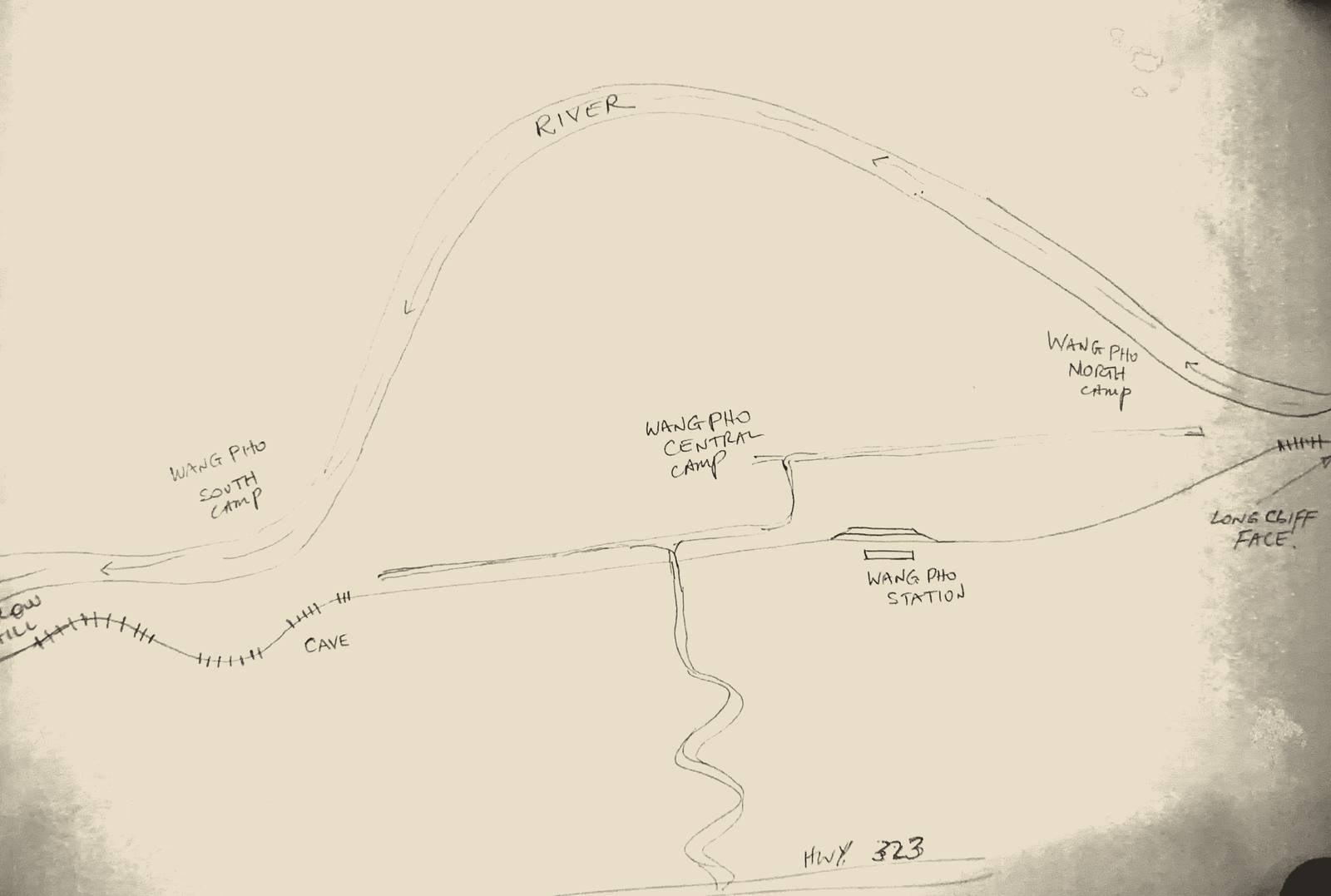
A pencil map, kept with Frank's papersThe three camps at Wang Pho, the place Frank calls Wampo.
The riverIt loops round the camps. The small arrows show which way it runs.
Central camp and the stationThe railway is the line with the cross ticks.
South camp and the caveThe line bends past a cave in the rock.
North camp and the long cliff faceHere the railway had to be carried along the cliff, above the river.
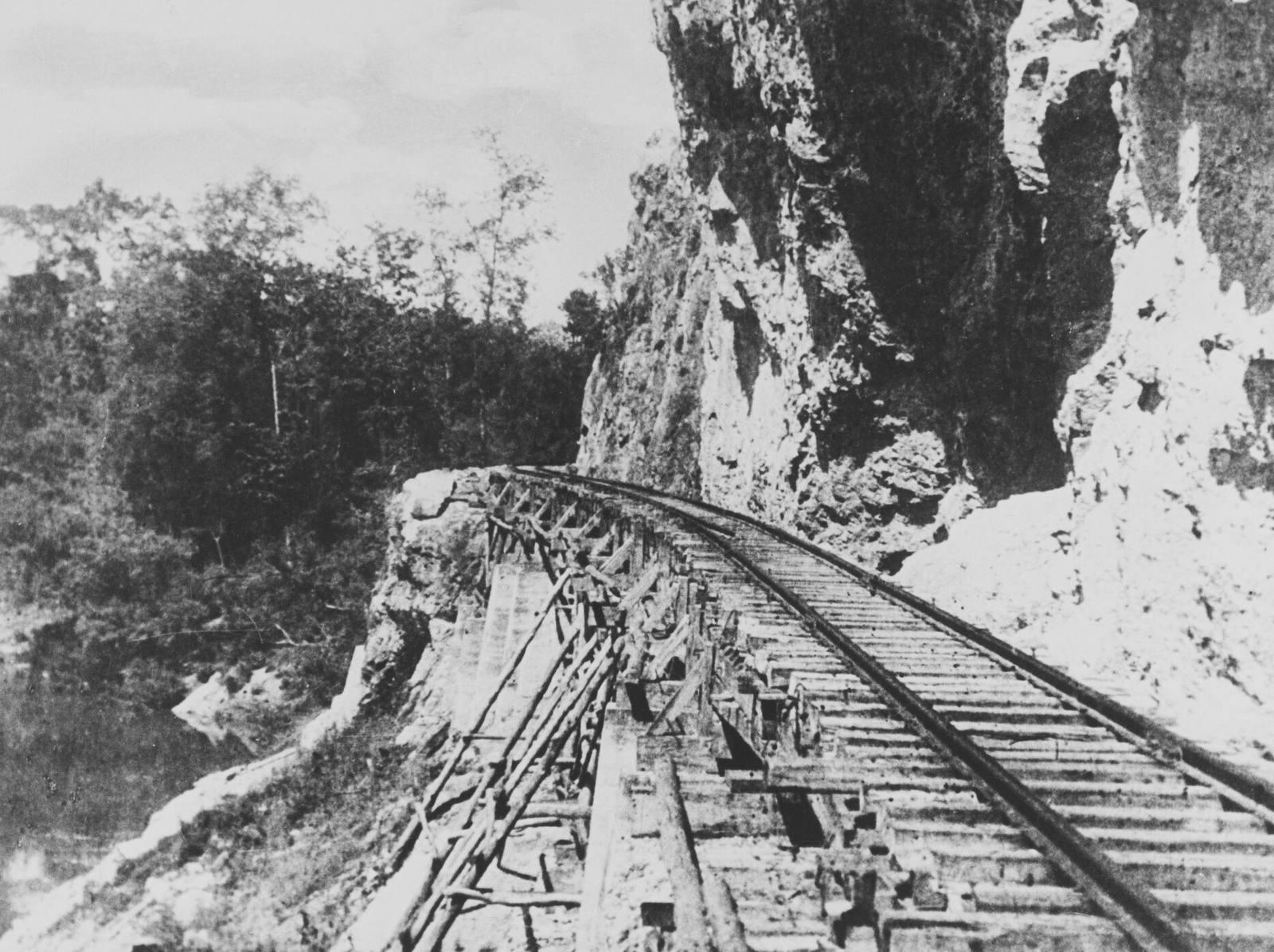
In the spring of 1943 the prisoners at Wampo built this timber viaduct along the cliff above the river, working in shifts through the night by firelight. Frank does not mention it by name. He was almost certainly there.
Wampo. Christmas 1942. Day 314.
My first Christmas as a POW I shall never forget. In Wampo we built a stage and had a concert. Many of the boys gave a turn. I myself was in the choir which our chaplain had got together. We sang our first Silent Night Holy Night. Our choirmaster said it sounded very good. Everything seemed very peaceful in the camp and in the jungle. The moon was shining at its best that night. At 12 o'clock our CO came on stage and gave us a speech. Afterwards we all sang Land of Hope and Glory.
Diary, December 1942Our CO was a great man and everybody respected him. He tried everything he could to make us comfortable and was not afraid to tell the Japanese CO what he thought of them and the way they ran things.
Diary, December 1942On his form Frank names the British camp leader at Wampo as “LT COL LILY”.
1943.
“Our worst year”
This was our worst year as POW. The Japanese wanted the job finishing at all costs. Our clothes were all worn out and no boots to our feet. Work would start very early and you may have to walk three or four miles a day in the jungle to get to your work. You did not know what time you would get back.
Things were certainly bad. Lots of us got ulcers on our legs which were caused through scratches from the bamboo. In a matter of hours you would have a big wound on your leg.
You could see every operation being done with such things as a pen-knife and a butcher's saw for our medical officers could not get the things they wanted to do these jobs. They were great men and did their job well.
Diary, 1943In 1943 the Japanese drove the work to a deadline. The prisoners called it “Speedo”, after the order shouted at them. It ran through the monsoon, with cholera in the camps.
The two ends of the line met in late 1943.

Tarsao. 16 May 1943. Day 456.
Peter remembers
Dad told him that when cholera struck a camp the guards kept away, and that the hardest task of all was burning the dead to stop it spreading.
We had lost a lot of men now. The rail-road was finished and all that had to be done was to keep it in repair.
To all the dead on the rail-road they build a kind of monument. Those of us that came back were very lucky.
Diary, August 1943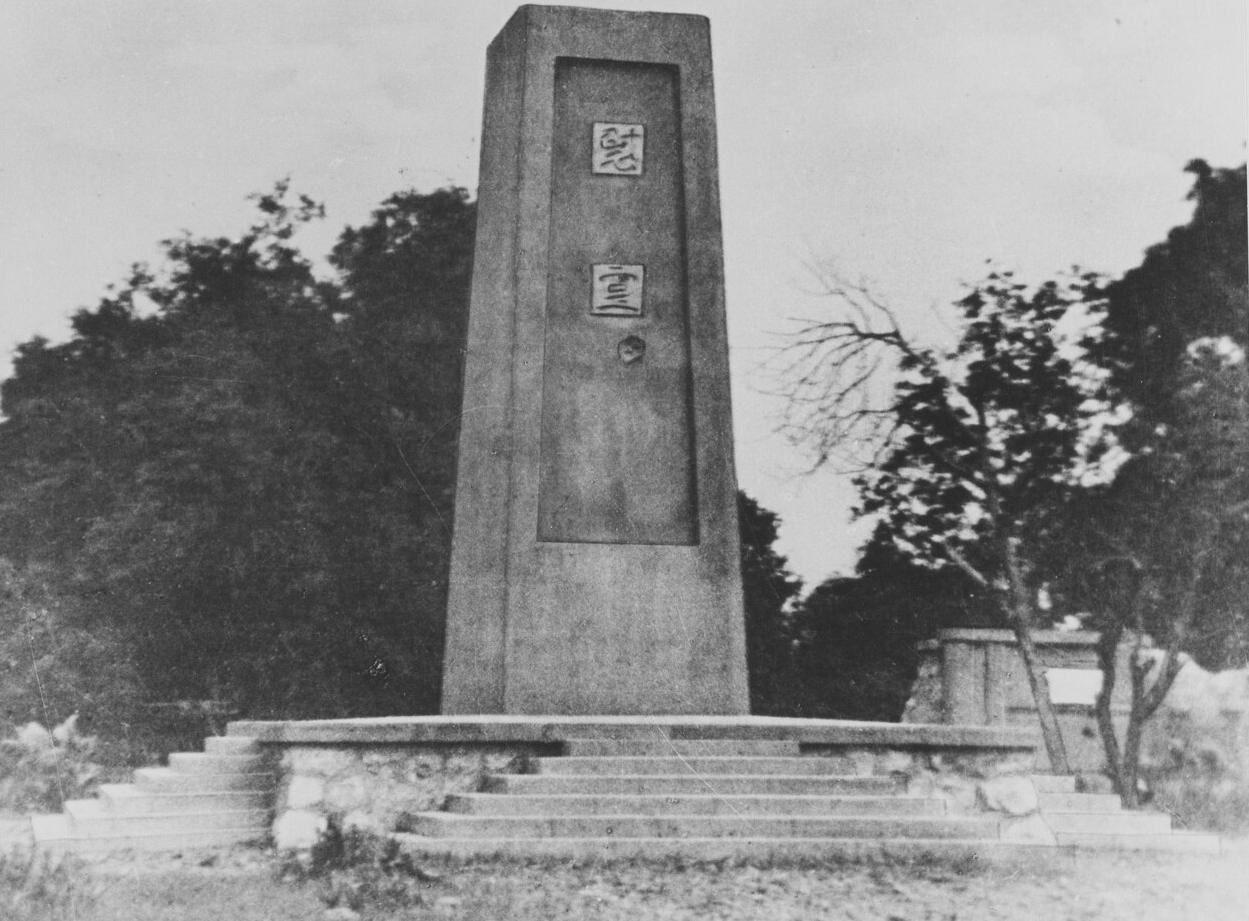
Railroad of Death. A poem by Frank.
You're asking me of railroads
And what they cost to build;
I know of one 'neath a blazing sun
Where the youth of an Empire was killed.
A long slim line of railroad,
A glittering metal thread
Built by the blood of my comrades,
Twenty thousand of them dead.
You think of gold and silver,
And the things that money can buy;
They were no avail on that Terror Trail
Where men were left to die.
They toiled till their backs were broken,
Till their breath was well-nigh spent,
Then staggered back to an Atap shack
Or a battered rag of a tent.
They knew the pain of hunger,
Sickness and fevered moans,
Think of that thread of railroad
Bordered by their bones.
You were asking me of railroads,
Wondering what they cost;
Remember the one in Thailand,
Remember the lads we lost.
F. H. Wampu
A field of dots, each one a hundred men. Allied prisoners who worked on the railway: over 60,000, of whom between about 12,000 and 16,000 died. Asian labourers who worked on it: roughly 180,000 to 250,000, of whom between about 75,000 and 100,000 died.
Allied prisoners who worked on the railway: over 60,000
Between about 12,000 and 16,000 of them died.
Asian labourers who worked on it: roughly 180,000 to 250,000
Between about 75,000 and 100,000 of them died.
Nobody kept a full count. Each dot is a hundred men.
Allied prisoners
Asian labourers
Figures: Britannica, History.co.uk, roll-of-honour.org.uk and the Australian Department of Veterans' Affairs, as gathered for this page. Estimates vary.
Tarsao hospital. 21 November 1943. His 23rd birthday. Day 645.
“What a nice birthday present”
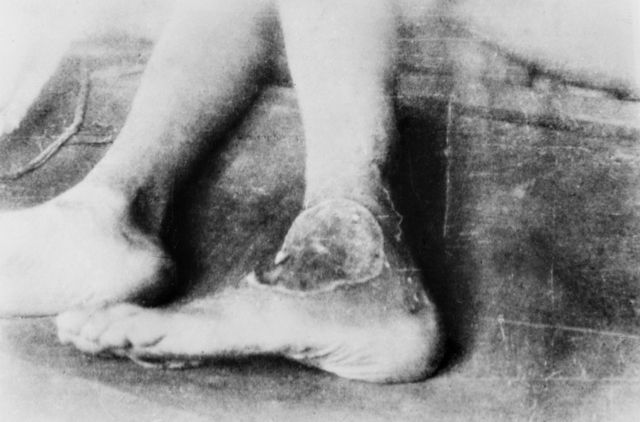
I was in the jungle in hospital with a nasty ulcer on my heel. I went in on my 23rd birthday and thought to myself what a nice birthday present. Here I was very ill and so were all the lads who were with me. Most of us would get malaria about every ten days which would cause your ulcer to get worse and all the treatment you had to get to get it better, you had to start again. I was lying on bamboo for six months with it before it got better.
All we get is dry cabbage which tastes like poison and rice. I shall be glad to get out of here.
Diary, Christmas 1943I just got my first letter from home. How happy I am to hear from home. It's 18 months old but I feel happy to know all is alright up to then.
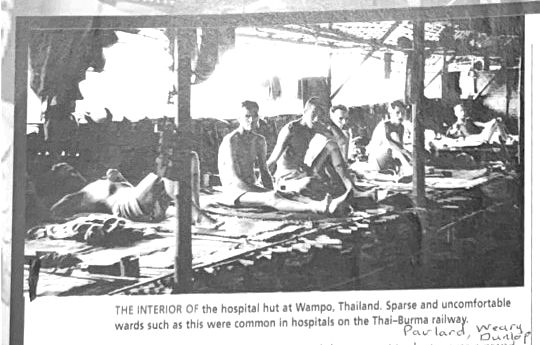
Diary, January 1944Tarsao was the base hospital for that stretch of the river. Nine days after Frank went in it held 2,407 patients. About 200 were surgical cases with large ulcers.
The beds were bamboo slats, 60 to 80 men to a hut.
Peter remembers
Dad told him maggots were put on an ulcerated wound to eat away the infected flesh.
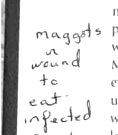
A note in the margin of the family's copy of the article.
A hard pictureThe photograph below shows a tropical ulcer. It comes into view slowly as you scroll. Scroll on past if you would rather not see it.

Tamarkan. 20 April 1944. Day 796.
“Only fifteen minutes”
We were taken by train on the railroad which we had built. We were all very pleased when we got there for it was very uncomfortable travelling down the rail-road. We were all soaking wet for it never stopped raining all the way down. This camp was the best we had been in since we were taken prisoners.
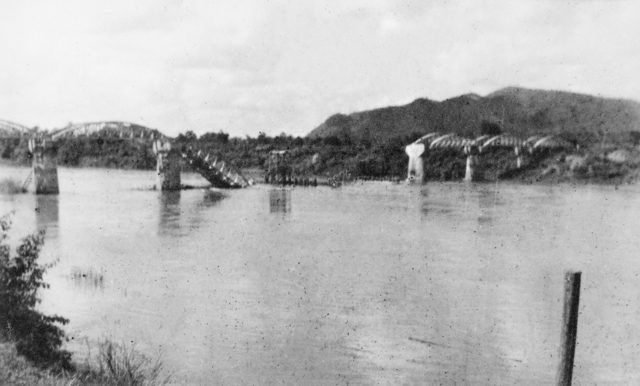
Diary, April 1944Tamarkan was the camp beside the bridge later made famous by a film. By 1944 it was a rest and convalescent camp. Frank's three weeks there match the dates on his form exactly.

Nakhon Pathom. 10 May 1944. Day 816.
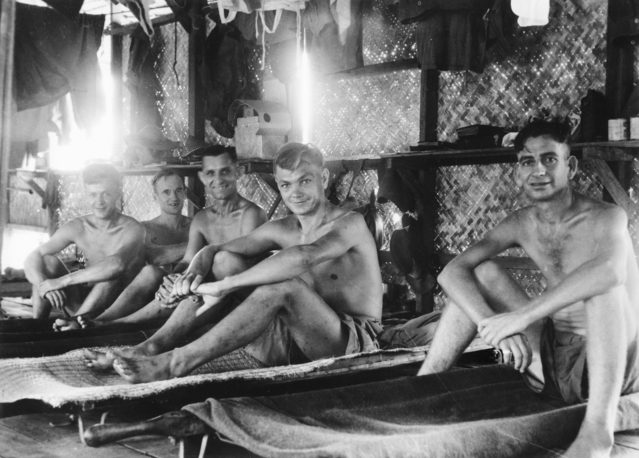
Nakhon Pathom was the largest prisoner of war hospital in Thailand, planned for 10,000 patients. Frank's form names its senior officer as “COATS”. Lieutenant Colonel Albert Coates, an Australian surgeon, was its chief medical officer.
Nakhon Pathom. 28 June 1944. Day 865.
I had to have an operation for a hernia which was caused through working on the railroad. I had seen many of the lads having operations in the past but little thought at the time that I would have to have one.
Here on the 28th June 1944 I had my operation fixed. My doctor was a great man. He had been with us most of the time on the railroad. I was a little nervous at first and then he told me not to worry for I should come out all right. It took him only fifteen minutes to do it and I saw the whole thing done. When I was taken to my hut I was feeling very sleepy. It took two months before I could walk about but it seemed like six.
Diary, April 1944His doctor was Lieutenant Colonel Edward “Weary” Dunlop, the Australian army surgeon later knighted for his work in the camps.
Frank told Phyllis Crossland, who typed up his diary in 1996, that the operation was done with a razor blade and without anaesthetic, and that he had to be held down.
Nakhon Pathom. August 1944.
I started to work again and was told I would go into the cook-house. My job was to cook the rice.
This man of ours had been a dentist before the war and knew nothing about medical things. If you looked O.K. to him then you were a fit man. How we would like to get hold of him!
Diary, August 1944Nakhon Pathom. Christmas 1944. Day 1,045.
I had just got a card from home and thought at the time what it would be like at home this Christmas.
We worked in the cook-house for thirty-six hours just to make the best of things we could out of rice and meat and vegetables. I started work on the 24th December at eight o'clock in the morning and finished at twelve o'clock on Christmas night. Still, it was worth it. For the lads who lay sick on their beds, most of us knew what it was like to be lying there, hoping for the best.
Diary, Christmas 1944Nakhon Pathom. August 1945.
“The war is now over”
We started to get air raids round about us. This was cheering us up a bit for we had not seen our Air Force for a long while. They used to drop leaflets round about us.
Diary, New Year 1945The Japanese guards who used to despise you seemed to be looking very worried. They would say to you, "Very soon you go to England and I to Japan."
Diary, August 1945Our Air Force came over on a leaflet raid. I've just got one to look at. We cannot read it for it is written in Japanese. On one picture it shows Lord Louis. Also the ATOM bomb - something we had never heard of. It also shows some Japanese prisoners taken in Burma. This looked good. I shall keep this leaflet for a keepsake.
Diary, August 15th 1945He did.
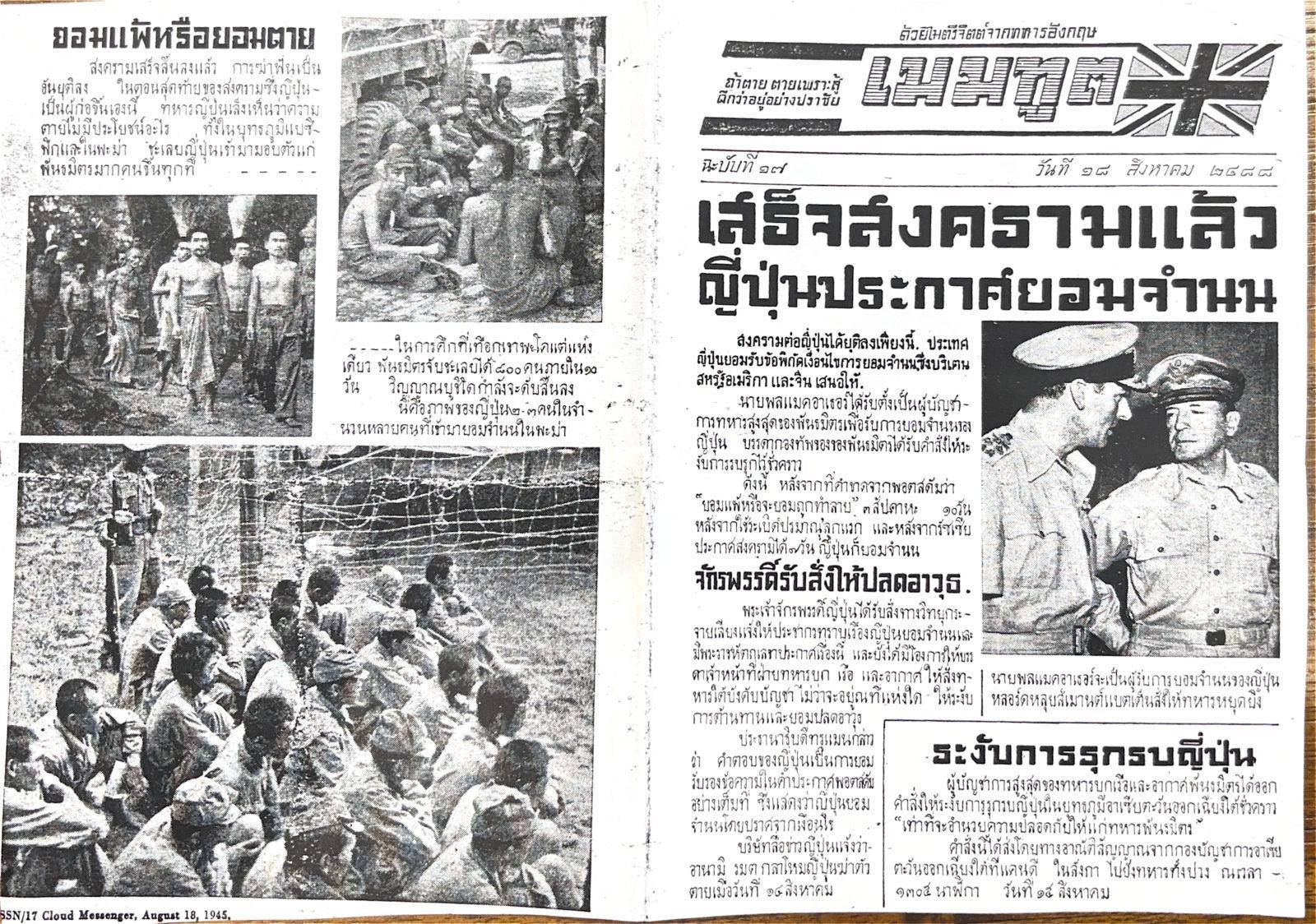
The headlineIt says: The war is over. Japan announces surrender.
The two commandersThe picture Frank describes. He knew one of them as Lord Louis.
Prisoners taken in BurmaJapanese soldiers behind the wire, on the left hand page.
Cloud Messenger, August 18, 1945Printed small at the bottom left. It is in Thai, not Japanese, which is why nobody in the camp could read it. This copy is dated three days after the date in the diary.
Japan's surrender was announced on 15 August 1945. Camps in Thailand heard over the next two days.
Allied aircraft dropped about 33 million leaflets over South East Asia.
Nakhon Pathom. 16 August 1945. Day 1,279.
What a day this was going to be. The Japanese guards are taking all their belongings from the Guard House. We asked them what was the matter. They said, "England Number One. Very soon you all go home."
That night
At night our C.O. would be giving a speech. All ranks must be there. All were very much looking forward to the night. At last it came and everything was silent. He stood there and all he said at first was, "Men, I have some good news for you all. I have been waiting to say this to you for a long, long time. The war is now over!" Nobody could believe it. Then someone shouted out, "Where's our flags?" One lad said, "Here it comes." Two of the lads were carrying a Union Jack at the end of a long bamboo. What a sight to see it again! As it was hoisted everyone stood to attention and sang 'God Save the King', the American National Anthem, and the Dutch.
We then had to send a telegram home to say we were still alive. Nobody slept that night. Everyone was singing to their heart's content.
Diary, August 16th 1945We had a Service for all at home and for those who had given their lives in this war. Not forgetting our comrades who were now lying at the side of the Railroad.
Diary, August 17th 1945Also we got our Red Cross parcels. Most of the food was no good, for the Japanese had stored it up for so long. It was dated 1942 and the year was now 1945.
Diary, August 18th 1945Nakhon Pathom and Bangkok. 20 August 1945.
“Free men”
We all said Good-bye to one another. Some of us would meet again at home but lots would never see again, such as those going to America, Australia, and Holland. All we could do was to write to one another when we got home.
Everything seemed very strange to see people walking round the streets. We still didn't have the idea that we were now free men.
Diary, August 20th 1945Bangkok. 21 August 1945.
At twelve o'clock we got into the plane. The Air Force lads made us as comfortable as they could. It got very cold in the air. We were all shivering for we had very little clothing on. When we reached Rangoon we were taken to the hospital where we were put into nice warm beds.
Diary, August 21st 1945RAF Dakotas flew freed prisoners from Bangkok to Rangoon. Frank flew on 21 August, among the first.
Rangoon. 21 August 1945.
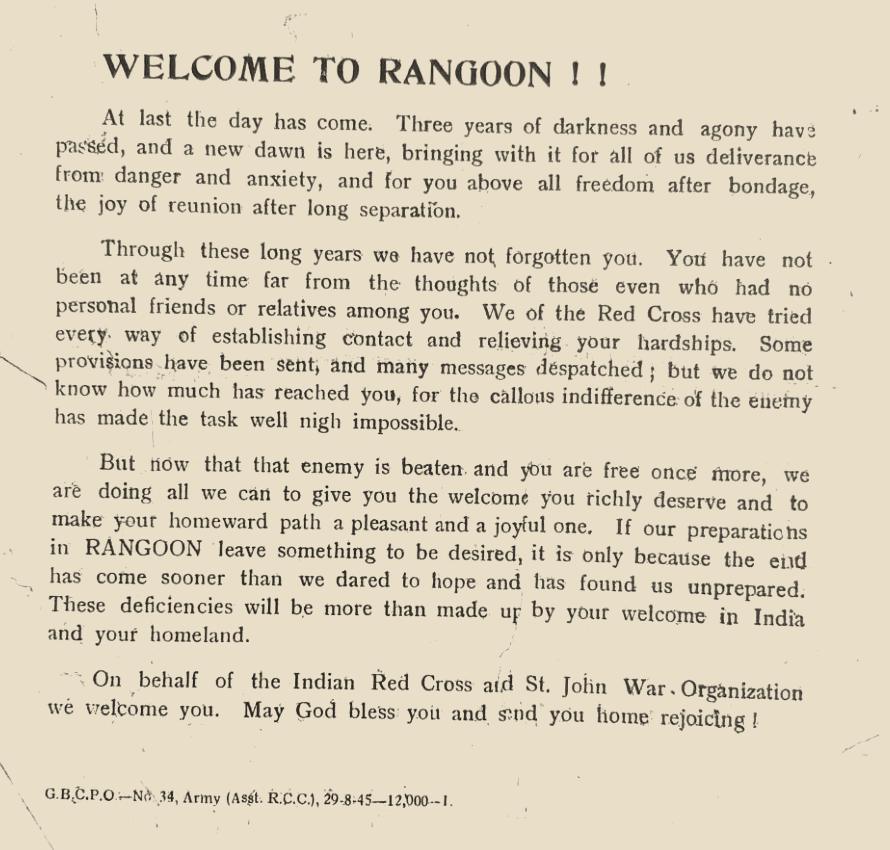
At last the day has come. Three years of darkness and agony have passed, and a new dawn is here, bringing with it for all of us deliverance from danger and anxiety, and for you above all freedom after bondage, the joy of reunion after long separation.
He spent just over three weeks in hospital in Rangoon.
When he was freed he weighed barely seven stone.
14 September to 7 October 1945. Rangoon to Southampton.
“Our old home called England”
14 September. Rangoon docks.
We started on our way to the docks and were told that we were very lucky lads for we were the first to leave for England.
Diary, September 14th15 September. At sea. Then Colombo.
It was a nice morning and everything very quiet as our ship started on her way for home. Seventy-two hours later we arrived at Colombo. What a day it was for us! The Red Cross was there and gave us a fine welcome. It was great to see our own country's girls and to speak to someone who could speak like you.
We were then taken back to the boat for we were now going to push on for our old home called England.
Diary, September 15th21 September. Indian Ocean.
Morning came and now the sea was just like a lake.
Diary, September 21st24 September. Aden.
It's now getting warm again. We did not see too much of Aden for it was getting dark.
Diary, September 24th26 September. Red Sea.
Still very hot. We shall be in Port Suez tomorrow and then we shall get our khaki.
Diary, September 26th27 September. Port Suez.
Here we are at the Port. What a fine sight to see!
We hope to be the first boat home, but one boat had started two days before us from Singapore.
Diary, September 27th4 October. The Mediterranean.
We are now through and on our way to Spain.
Diary, October 4th5 October. Gibraltar.
Here is Spain and it looks simply pretty. There I can see the Rock of Gibraltar in the distance. I have never seen such a sight in all my life as that Rock. It looks beautiful stood there all on its own in the water.
Diary, October 5thSunday 7 October 1945.
Sunday morning came. All the boys were on the decks waiting to see the shore of England once more. I can just see a narrow black line running out to sea. Then at last we saw the shores of home. We did not know what to say to one another. All we did was just stand and gaze at it. Then our minds went back to those who had given their lives for this England, never to see it again.
Diary, October 1945There was the 'Queen Mary' standing in the docks. You could not see her for people were all over her. As we passed her she gave us the Victory sign on her siren while all the folk were singing 'They'll always be an England' and waving their Union Jacks.
The Mayor welcomed us home as we stepped on to the shores of England and the Red Cross gave us some cigarettes and chocolate. It felt very queer to us and most of us asked if we were really home.
As we rode through the streets to our camp people were at either side of the road cheering and throwing flowers into our lorries. We had to go very slowly all the way.
Diary, October 1945The dates in the diary match the P&O liner Corfu almost exactly: Rangoon in mid September, Colombo three days later, Suez on 27 September, Southampton on Sunday 7 October 1945. She carried about 1,500 freed prisoners and was the first such ship to reach Britain. No passenger list naming Frank has been found, so this is almost certainly the Corfu.
On the quay each man was given a message from the King and Queen.
We mourn with you the deaths of so many of your gallant comrades.
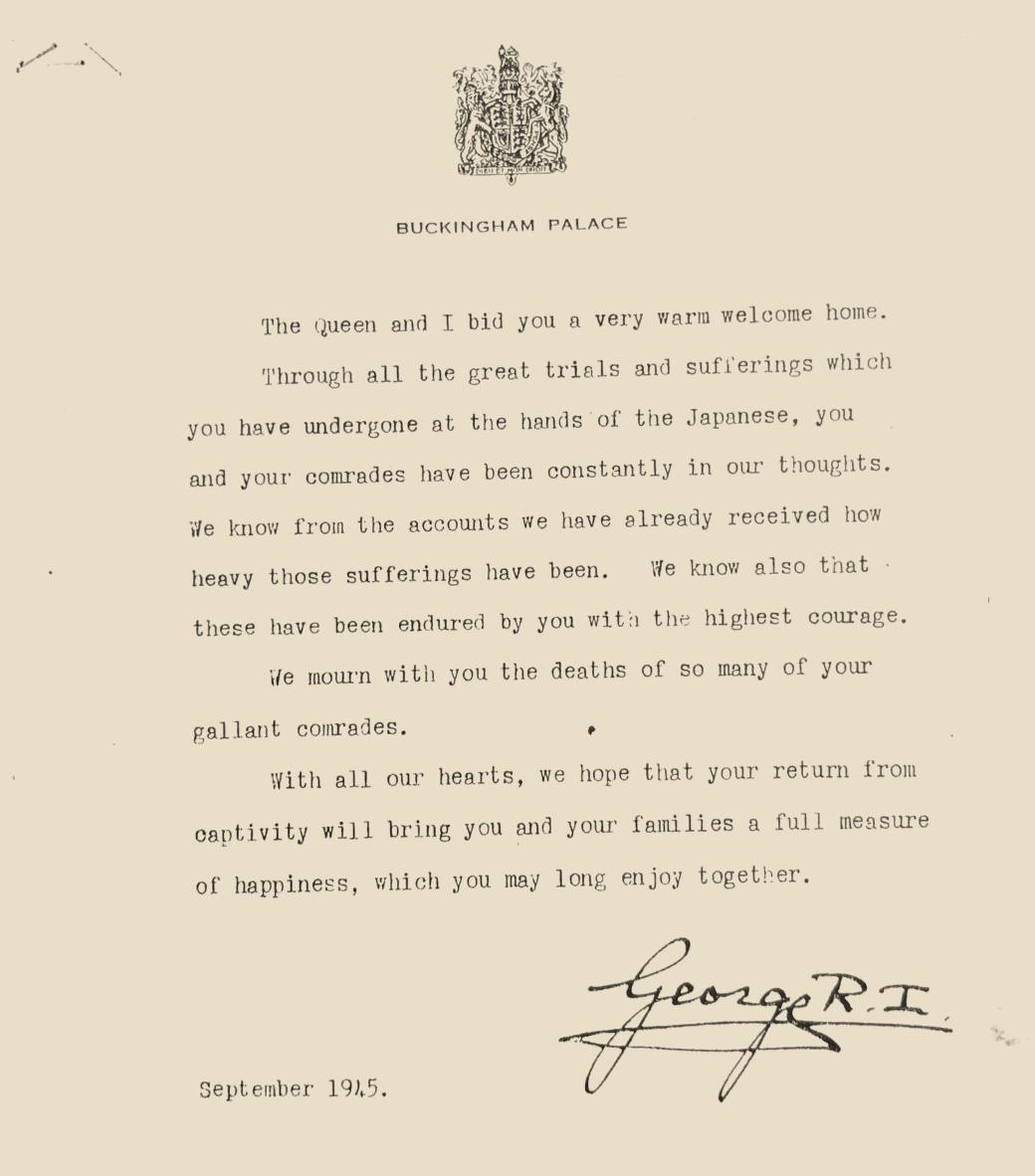
BUCKINGHAM PALACE
The Queen and I bid you a very warm welcome home.
Through all the great trials and sufferings which you have undergone at the hands of the Japanese, you and your comrades have been constantly in our thoughts. We know from the accounts we have already received how heavy those sufferings have been. We know also that these have been endured by you with the highest courage.
We mourn with you the deaths of so many of your gallant comrades.
With all our hearts, we hope that your return from captivity will bring you and your families a full measure of happiness, which you may long enjoy together.
George R.I.
September 1945.
Half a lifetime later
The picture that shocked Peter Hadfield. His father returns to England after three-and-a-half years as a Japanese prisoner.
'I saw him walking down the gang plank and recognised him immediately. It was sad because many of the men looked in very poor physical health but I was delighted to see him.'
Peter Hadfield, on seeing his father step off the ship at Southampton in a film of the homecoming.
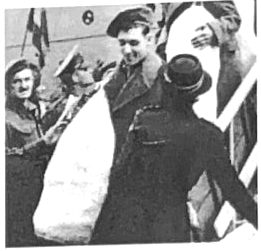
The photograph printed beside Peter's words in the magazine.
October 1945. Sheffield and Barnsley.
“It all seemed like a dream”
Next day we were on our way home. We all looked very white and wondered what it would be like at home.
When I got home it all seemed like a dream and everything around me was very strange. It was good to be with your own people again and to meet some of the boys from your home town who had been with you all through the past three and a half years in the jungle.
Diary, October 1945Peter remembers
At Sheffield station a meal had been laid on, but after three and a half years of rice Dad could not eat it. When the driver of the Barnsley train heard he had a Far East prisoner aboard, he promised to get him home as fast as the engine would go. A gentleman from the Army opened his briefcase, took out a bottle of whisky and toasted him. The family were waiting at Court House Station, Cousin Ernest among them. Dad said that seeing his mother on that platform was one of the most touching moments of his life.
Peter's notes say Frank then spent nine months at a camp at Menston, being built back up on a European diet.
Phyllis Crossland wrote that it was months before he could eat meat again, and that at 27 he needed false teeth because of the years of hunger.
And now, when we meet, we look back on those days which were always dark. Then we say to one another that still it was worth fighting for, this country, old England, the Land of the Free.
The last words of the diary1946 to 1996. Monk Bretton and Kendray, Barnsley.
The years after
No words of Frank's survive from these years, so this part is told in the family's memories and in one paper he kept.
He went back to work, at Monk Bretton Colliery. He married Violet. They lived at Kendray.
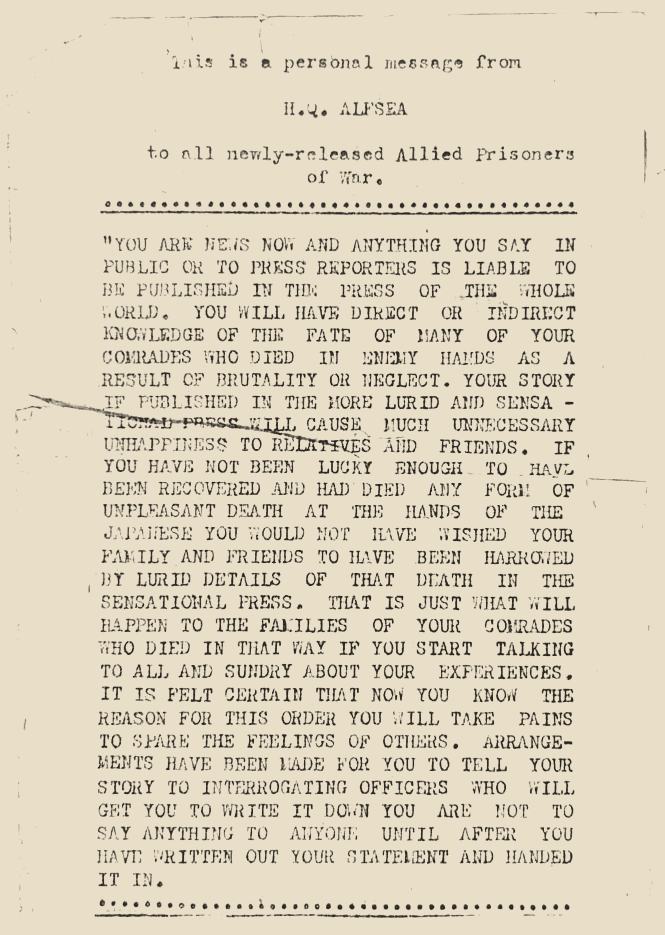
Before they sailed, every freed prisoner was handed this.
YOU ARE NOT TO SAY ANYTHING TO ANYONE UNTIL AFTER YOU HAVE WRITTEN OUT YOUR STATEMENT AND HANDED IT IN.
Read the whole message as text
This is a personal message from H.Q. ALFSEA to all newly-released Allied Prisoners of War.
"YOU ARE NEWS NOW AND ANYTHING YOU SAY IN PUBLIC OR TO PRESS REPORTERS IS LIABLE TO BE PUBLISHED IN THE PRESS OF THE WHOLE WORLD. YOU WILL HAVE DIRECT OR INDIRECT KNOWLEDGE OF THE FATE OF MANY OF YOUR COMRADES WHO DIED IN ENEMY HANDS AS A RESULT OF BRUTALITY OR NEGLECT. YOUR STORY IF PUBLISHED IN THE MORE LURID AND SENSATIONAL PRESS WILL CAUSE MUCH UNNECESSARY UNHAPPINESS TO RELATIVES AND FRIENDS. IF YOU HAVE NOT BEEN LUCKY ENOUGH TO HAVE BEEN RECOVERED AND HAD DIED ANY FORM OF UNPLEASANT DEATH AT THE HANDS OF THE JAPANESE YOU WOULD NOT HAVE WISHED YOUR FAMILY AND FRIENDS TO HAVE BEEN HARROWED BY LURID DETAILS OF THAT DEATH IN THE SENSATIONAL PRESS. THAT IS JUST WHAT WILL HAPPEN TO THE FAMILIES OF YOUR COMRADES WHO DIED IN THAT WAY IF YOU START TALKING TO ALL AND SUNDRY ABOUT YOUR EXPERIENCES. IT IS FELT CERTAIN THAT NOW YOU KNOW THE REASON FOR THIS ORDER YOU WILL TAKE PAINS TO SPARE THE FEELINGS OF OTHERS. ARRANGEMENTS HAVE BEEN MADE FOR YOU TO TELL YOUR STORY TO INTERROGATING OFFICERS WHO WILL GET YOU TO WRITE IT DOWN YOU ARE NOT TO SAY ANYTHING TO ANYONE UNTIL AFTER YOU HAVE WRITTEN OUT YOUR STATEMENT AND HANDED IT IN.
Peter remembers
Dad never spoke much about the war, to anyone, until later in life.
Peter remembers
A man who worked with him said that at break times Dad would crouch low to the floor to eat his sandwiches, looking about him as he ate.
Peter remembers
Mam once made a rice pudding. After three and a half years of rice, the dish ended up against the dining room wall.
Peter remembers
As they got older, Mam and Dad grew closer together, mellowing with age.
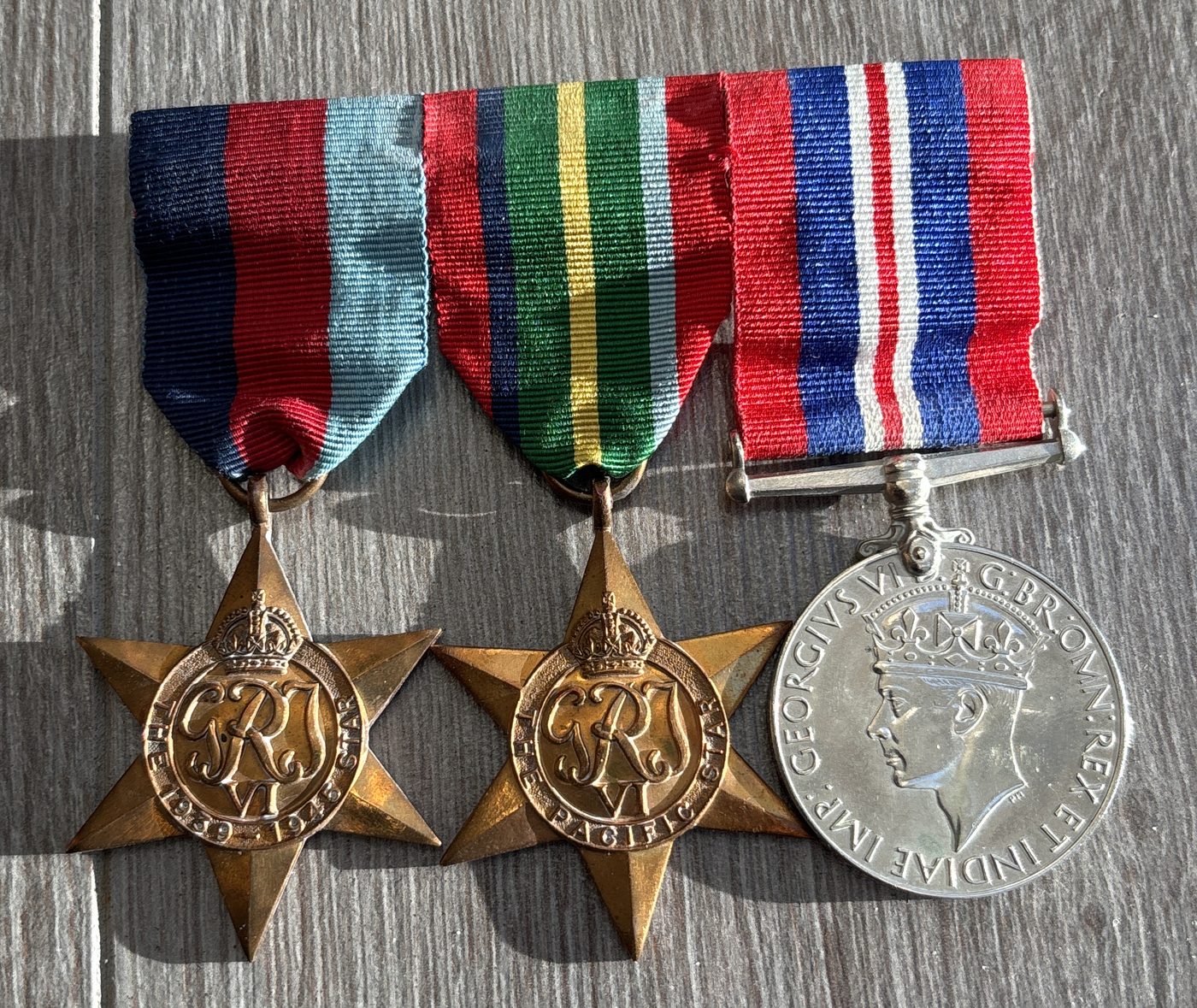
1996.
In 1996, a patient in Barnsley's Mount Vernon Hospital, Frank showed a visitor his diary. She was Phyllis Crossland, and she typed it up that August.
At seventy-five, I saw him as a tall, thin man, still erect, though in poor physical health due, in some degree, to the privations he had suffered during World War II. His mind, however, was quite clear, and he was willing to talk to me about his experiences. Phyllis Crossland, in her foreword to the 1996 edition of the diary.
Frank died in 1996, aged 76.
Frank Hadfield. Born 21 November 1920.
Eight days apart.
Peter Hadfield. Born 29 November 1948.
I went in on my 23rd birthday and thought to myself what a nice birthday present.
Diary, Christmas 1943Dad,
Granddad would have been 106 on the 21st of November. Eight days later it is your birthday.
In 1943 he went into a jungle hospital on his birthday, and wrote in his diary that it was a nice birthday present. I think he was owed a better one. So this is for both of you.
He wrote it down so it would not be lost. You kept it safe. All I have done is put it in order.
Happy birthday.
Pete
About this page
What is what
Frank's words are set in the large serif type. They are taken from the edition of his diary prepared with him by Phyllis Crossland in August 1996. The first two lines of the diary, under Chapter 1, come from the raw typed copy of the original. His two poems and the leaflets, letters and form he kept are copied word for word from the family's papers. Nothing has been added to Frank's words or changed. The history in the smaller plain type is not his. Peter's memories are in the paper cards headed Peter remembers.
What is uncertain
- The ship home. The dates in the diary match the P&O liner Corfu almost exactly, but no passenger list naming Frank has been found, so it is almost certainly the Corfu.
- The date on the Thai leaflet. This copy is dated 18 August 1945, three days after the date in Frank's diary. The translation of its headline is by the family's transcriber.
- Menston. Peter's notes say Frank spent nine months at a camp there. No other source has been found.
- Who drew the pencil map of the Wang Pho camps. It was kept with Frank's papers.
- Frank's unit. The form reads 16 Def Regt RA, but the handwriting is not fully clear.
Pictures and papers
- Portrait, the Home Guard photograph, the hospital hut photograph, the photograph beside Peter's words and the margin note: from the newspaper cutting and the magazine article kept by the family. The newspaper cutting is probably from the Barnsley Chronicle. The magazine article, Guest of the Rising Sun, is by Laura Whitaker.
- Liberation form, the pencil map of the Wang Pho camps, the Thai leaflet, the Welcome to Rangoon leaflet, the King's letter and the H.Q. ALFSEA message: the Hadfield family's own papers.
- Officers walking to the surrender, Singapore, 15 February 1942: Imperial War Museums HU 2781, public domain, via Wikimedia Commons.
- The railway at Wang Po: photographer unknown, KITLV 25517, Leiden University Libraries, CC BY 4.0 (creativecommons.org/licenses/by/4.0). Cropped and shown in greyscale.
- The memorial the Japanese built for the railway dead, at Tamarkan: photographer unknown, KITLV 25531, Leiden University Libraries, CC BY 4.0. Cropped and shown in greyscale. The date of the photograph is uncertain.
- Tropical ulcer, Tarsau, 1943: Australian War Memorial P00761.009, public domain.
- The two bridges at Tamarkan, about October 1945: War Graves Commission survey party, Australian War Memorial P01932.005, public domain. Cropped and shown in greyscale.
- Prisoners being treated in Ward 18 at Nakhon Pathom, 18 September 1945: Norman Bradford Stuckey, Australian War Memorial 118855, public domain. Cropped and shown in greyscale.
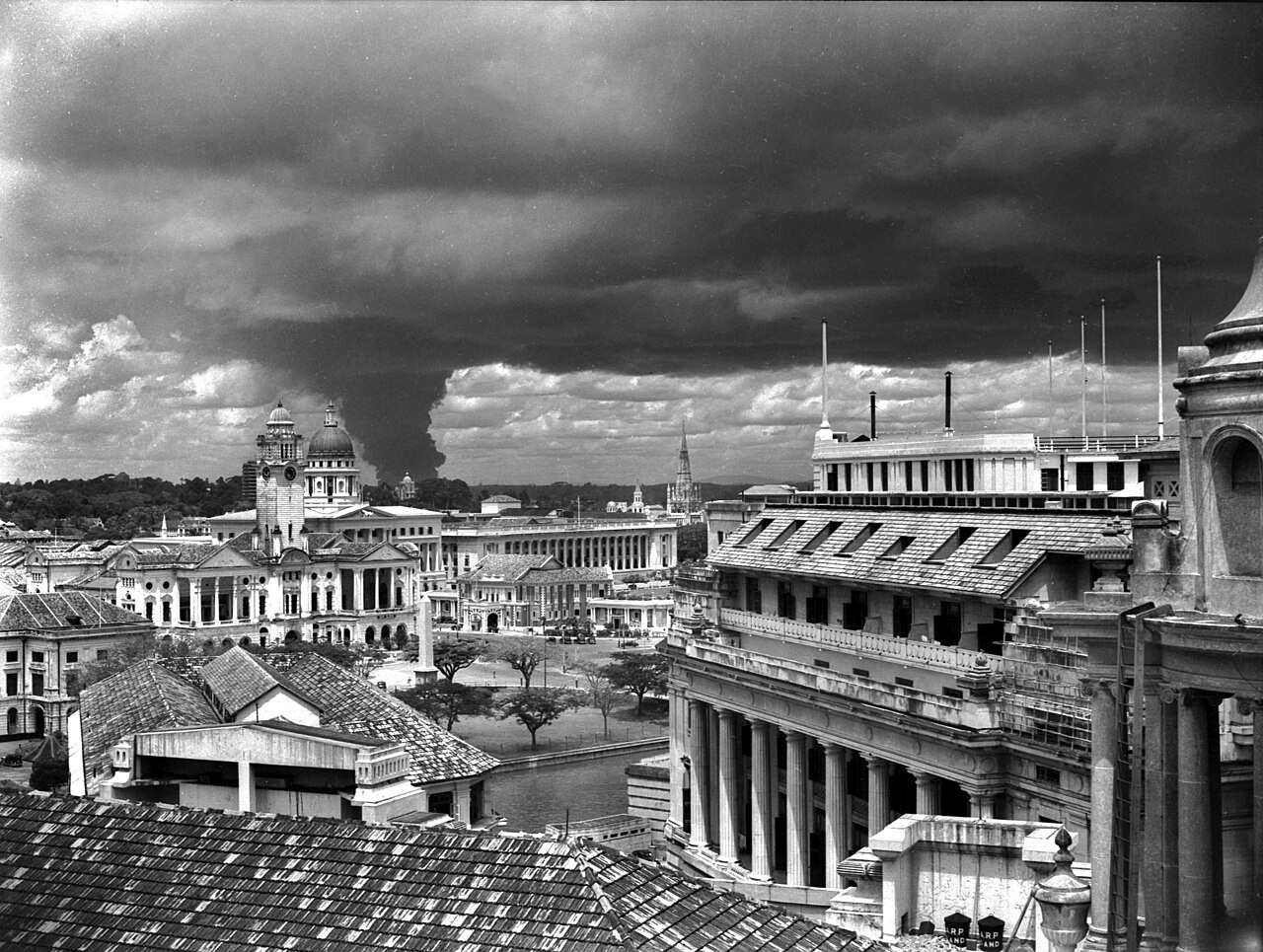
- Faint background, Singapore: smoke from the burning oil tanks at the Naval Base, seen over the city, 1942. Clifford Bottomley. Public domain (UK Government photograph), via Wikimedia Commons, file "Burning oil fields.jpg".
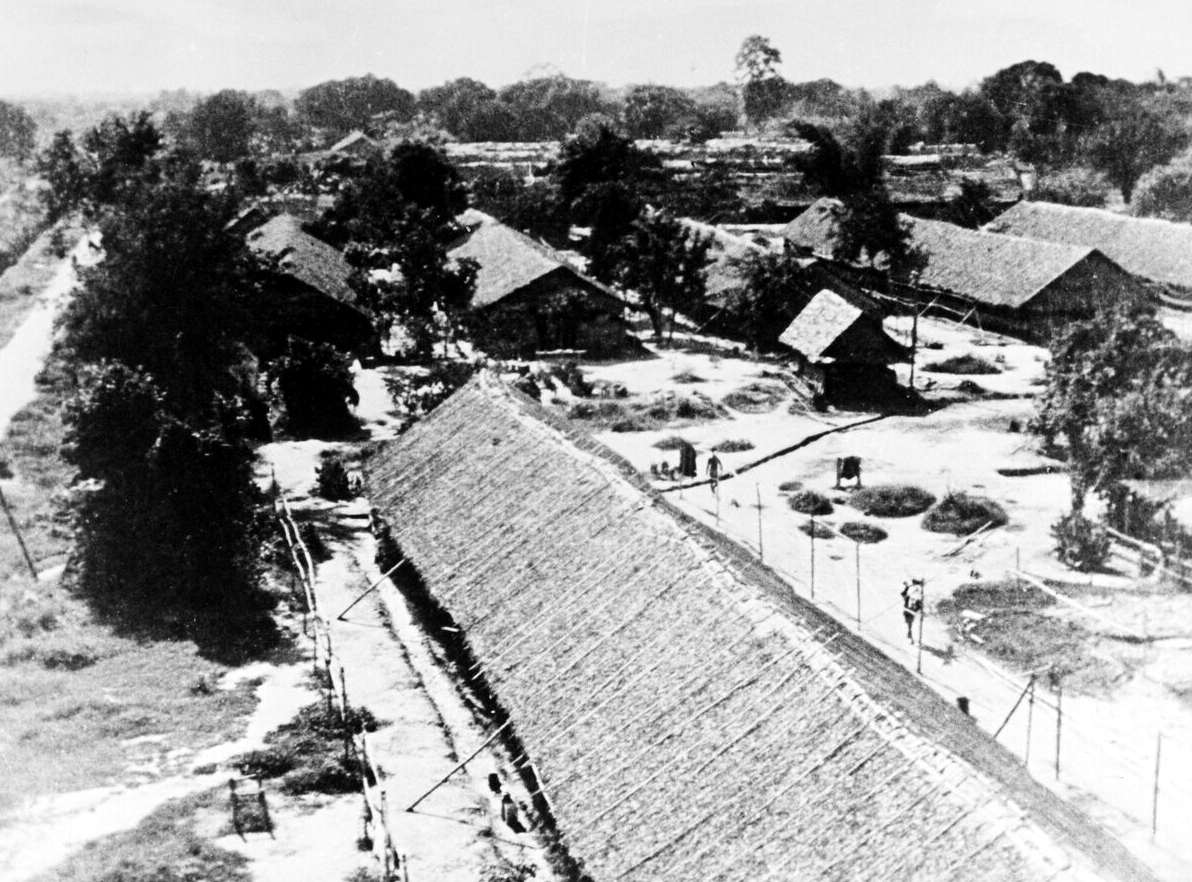
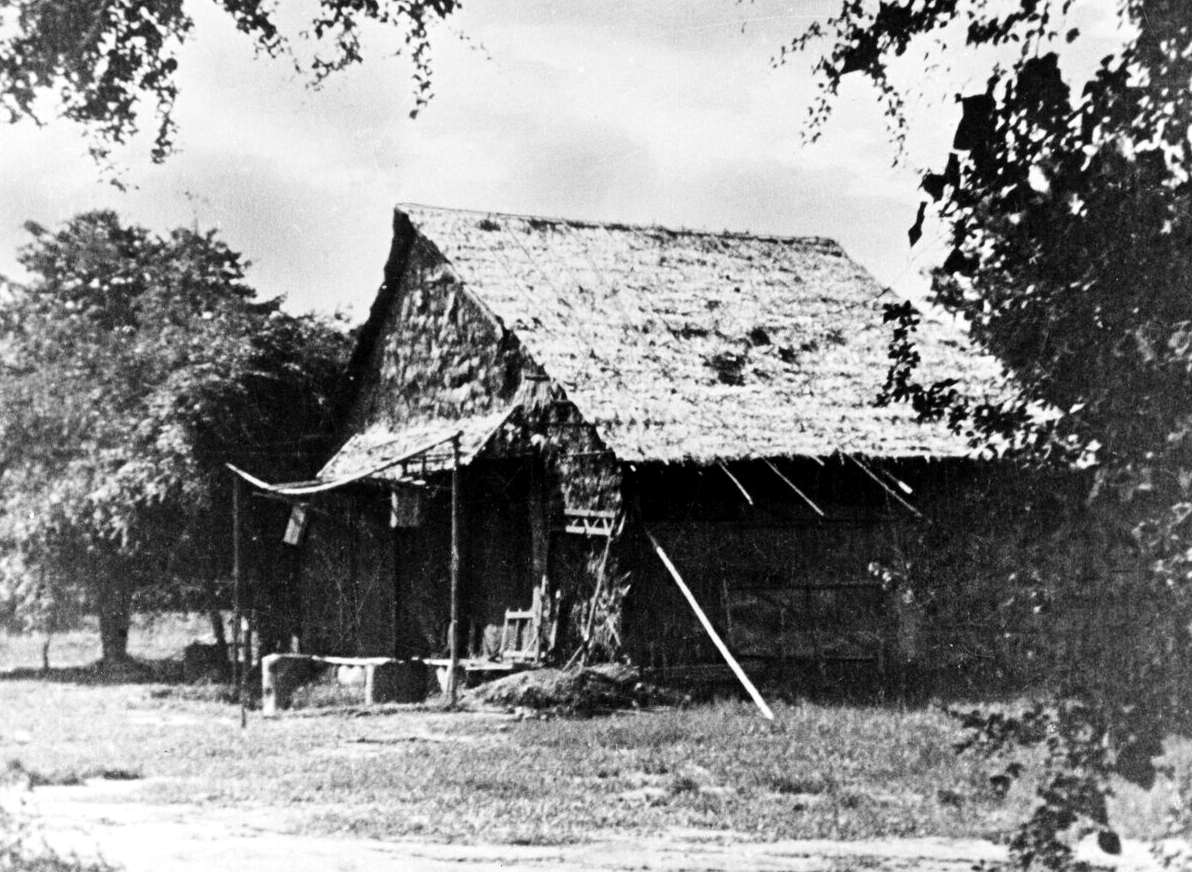
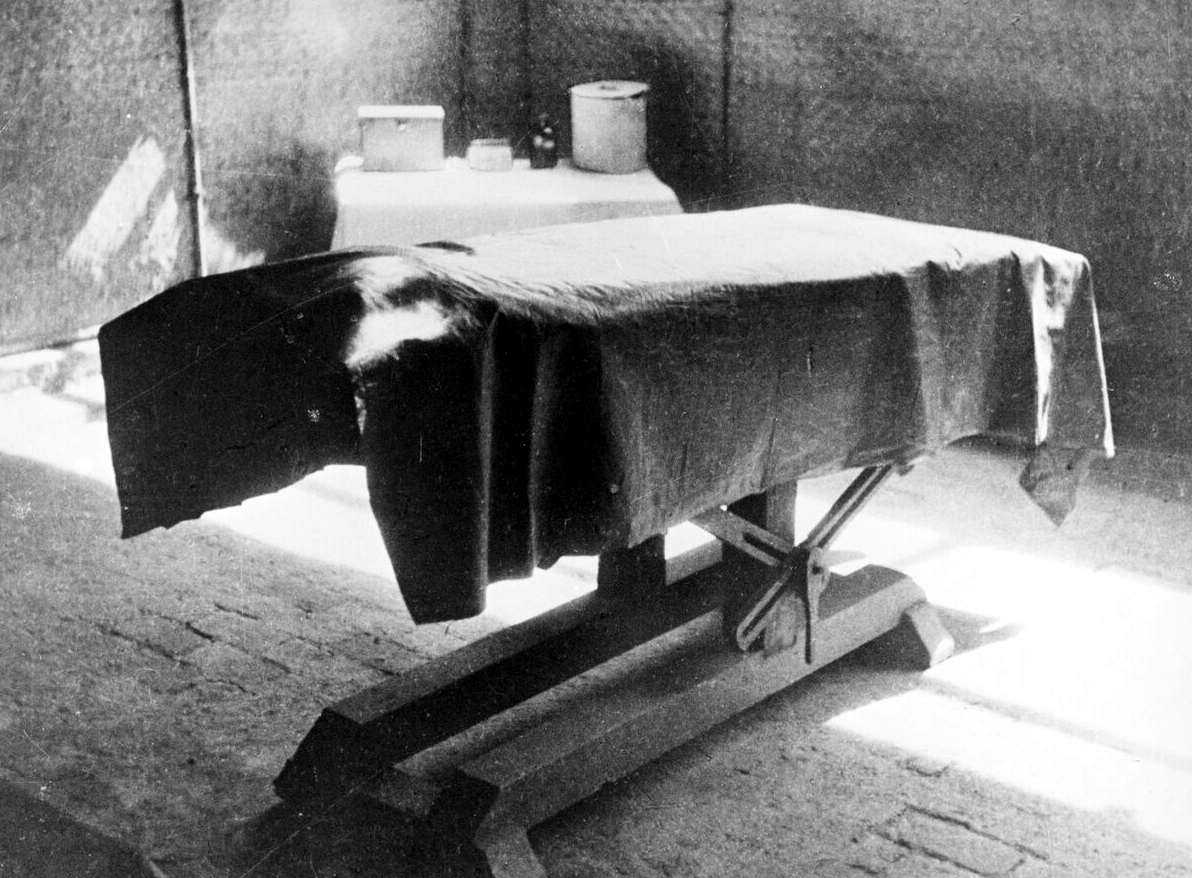
- Faint backgrounds, the camps: Tamuan camp seen from the watch tower (KITLV 25529), the theatre hut at Tamuan (KITLV 25530) and the operating room at Tamuan (KITLV 25528). Photographers unknown. Leiden University Libraries, CC BY 4.0. Cropped, darkened and shown faintly. Tamuan was another camp on the same railway. Frank was not held there. These pictures are for atmosphere only.
- Map coastline: Natural Earth, public domain. The route and the river above Kanchanaburi are drawn approximately.
Sound
Every sound is made by this page as you read: footsteps, wheels, water, birds, rain, a far off crowd, an aircraft, a ship's engine and the sea, a railway station. Nothing is recorded and no one else's performance is used. The notes heard at Christmas 1942 are the opening of Silent Night, and those heard as the flag goes up are God Save the King. Both tunes are long out of copyright. There is no sound on Railroad of Death.
Sound is on unless you choose to read in silence. A browser cannot play anything until the page is first touched, so it begins with your first tap.
With thanks
Phyllis Crossland, who sat with Frank in 1996 and typed up his diary. Laura Whitaker, who told his story in print.